
How to use AI in Sales Prospecting: 5 Practical Applications to Boost Conversions


Dalia Arroyo
A recent Gartner study shows that AI can save salespeople an average of 5 hours per week, yet barely 70% of sales organizations reinvest time in high-value activities. This shows a knowledge gap in understanding how to use AI in sales prospecting.

Download the Ultimate B2B Appointment Setting Guide
Download the B2B Appointment Setting Guide to learn how to properly prospect and cold-call best practices.
What is AI in Sales Prospecting?
AI in sales prospecting utilizes technology with machine-learning capabilities to enhance the business development process, including lead scoring, prospect identification, and improving live conversations.
EBQ Tip
Since AI is such a buzzword today, some sales tools on the market are now just repackaged marketing automation tools. For example, a few LinkedIn “AI” tools we see are marketing automation tools that allow salespeople to mass message prospects.
So make sure you understand the difference between automation and AI before investing in a tool.
How reps use AI for sales calls
Before we list out how you can use AI in sales prospecting, we want to make one thing clear: AI should not replace the entire human sales process. After all, people like to be treated as intelligent human beings — not someone who can be tricked by AI to cut corners.
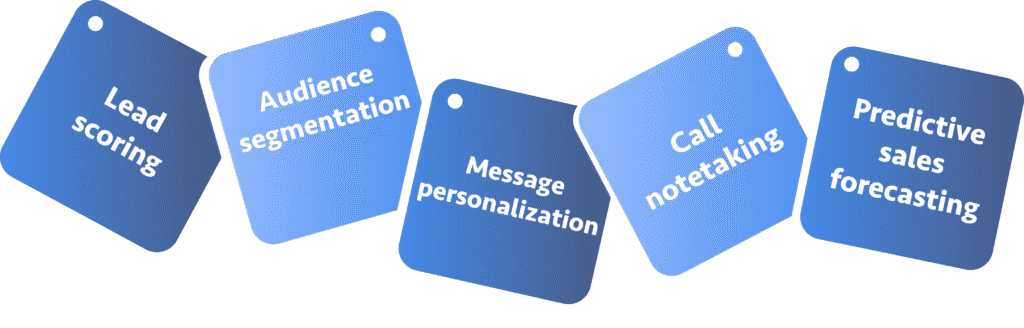
But with sales reps spending 70% of their time on non-selling activities, there is ample room for AI to help manage a few administrative tasks. Here are five practical ways to use AI during your sales calls:

Subscribe to EBQ's Bimonthly Newsletter
1. Lead scoring
AI-powered lead scoring automatically ranks your prospects by their likelihood to convert and their similarity to your ideal customer profiles (ICPs), enabling your reps to prioritize contacts more effectively. Instead of manually scoring each prospect based on gut feeling and spreadsheets, AI can analyze multiple signals simultaneously (such as firmographic fit, engagement behavior, and intent data from third-party sources) and assign each lead a score in real time.
Reps can now focus their outreach energy on high-scoring leads, while lower-scoring leads enter an automated sales cadence. This results in a lower sales cycle and a higher win rate because your team is working the right opportunities at the right time.
2. Audience segmentation
Similar to lead scoring, AI can use the same intent signals to identify patterns among your prospects and segment groups into precise cohorts that share key characteristics, such as industry vertical, tech stack, or behavioral patterns. These micro-segments allow your team to craft outreach that speaks directly to each group’s specific pain points and priorities.
AI makes audience segmentation dynamic by analyzing prospects’ behavior changes in real time and automatically moving them between segments. Better segmentation means more effective email marketing, higher open rates, more replies, and fewer unsubscribes because your prospects feel understood rather than spammed.
3. Message personalization
Even if you are cold emailing your prospects, modern buyers expect outreach that feels relevant to their unique situation. AI allows you to create dynamic content that pulls real-time context, such as a prospect’s recent LinkedIn activity or their company’s latest announcements, to automatically weave that context into your emails.
As the AI does all the heavy lifting in research and drafting, the sales rep can review before sending. This approach lets a single rep personalize messages at a volume that would have otherwise required a full research team.
4. Call Notetaking
Taking a cold call is difficult. You have to stay engaged during a call and respond to objections, all while taking notes and transcribing the conversation. With AI as a silent participant in the call, your reps can now focus on staying fully present as the AI tool takes notes for them.
After the call, AI can surface key action items, highlight objections, and note any follow-up commitments before logging them directly into your CRM system. Over time, AI can also identify patterns within the call transcripts and use insights as a coaching resource. Managers can review these notes to quickly identify which talk tracks are working, which objections keep appearing, and where individual reps need improvement.
5. Predictive sales forecasting
Traditional sales forecasting often heavily relies on self-reporting. At times, these numbers can be manipulated to show inflated growth.
With AI forecasting, it replaces gut-feel with hard data. The model is trained on historical sales pipeline data, current CRM activity patterns, and seasonal industry trends for better prediction. Sales leaders can now get an honest, data-driven picture of how many deals are likely to close this quarter, which are at risk of slipping, and where the pipeline has potential coverage gaps — allowing for early intervention and resource reallocation.
Subscribe to EBQ's Bimonthly Newsletter
Before you use AI in business development
Almost every AI tool on the market brags about how easy it is to integrate with your current workflows, but many business leaders take that to mean “plug and play without any setup.” As a result, more than 90% of B2B AI projects are doomed to fail.
So before you install your AI tools, there are three considerations you must consider:
Accurate ICPs
Your AI tool needs accurate input and goals to do meaningful work for you. If your ICP is vague, outdated, or invalidated, the system can surface inaccurate insights that result in slower pipeline velocity.
Data cleanliness
While AI is a robust tool, they still operate under the same philosophy: garbage in, garbage out. If your CRM is cluttered with bad data, your AI will waste time and resources chasing dead ends and produce unreliable forecasts.
Team adoption
The whole point of implementing AI into your system is to save time on manual tasks, but that only works if your team uses it. However, many sales reps are resistant to AI because of perceived job insecurity.
Make sure to have a plan to address all three of these considerations before fully implementing your AI tool. If you’d like insight into how EBQ can help you address these potential roadblocks, contact one of our RevOps consultants.
Download the Ultimate B2B Appointment Setting Guide
Download the B2B Appointment Setting Guide to learn how to properly prospect and cold-call best practices.
The future of AI in B2B Sales
While AI’s role in B2B sales is still in its infancy, the trajectory is clear: AI will become the core of any competitive sales organization. Conversational AI will only improve, allowing for more personalized outreach in less time.
But one thing is certain: AI can not replace humans when it comes to building genuine relationships. You still need expert business development reps who understand how to use the latest technology to accelerate your sales goals.
If you’re looking for an expert partner, our appointment setters bolster your sales pipeline by using the latest sales development tools to find relevant decision makers and nurture them. From there, they can hand off any sales-ready lead to you so your salespeople can focus on closing more deals.
About the Author:
Dalia is EBQ’s VP of Business Development with over 10 years of experience in customer service. After forming the Customer Experience division, she achieved over $1.2M in revenue within the first six months under her leadership.