


How to Build a LinkedIn Company Page That Actually Drives B2B Growth

How to Build a LinkedIn Company Page B2B Growth Engine

Over 70 million businesses have a presence on LinkedIn, but only a fraction of them have a profile that actively works for their business. For B2B organizations, a fully optimized LinkedIn company page isn’t just a digital business card. It’s the cornerstone of your corporate identity online, the first place a prospect goes to validate your credibility, gauge your brand authority, and assess whether you’re worth a conversation.

TL;DR: Optimizing the anatomy of your B2B LinkedIn company page turns sporadic posting into a predictable engine that surfaces early buying signals and accelerates revenue operations.

Enterprise buying committees average six to ten decision-makers, and they start forming opinions long before your sales team gets involved. For most of them, your LinkedIn company page is the first impression. If your page looks abandoned, generic, or incomplete, that first impression quietly works against you before a single sales call is booked.

There’s also a critical, often-overlooked SEO dimension. AI-powered search engines and knowledge graphs now determine entity authority in part through third-party platforms, including social media profiles, review sites, and professional directories. A consistently branded, keyword-rich LinkedIn page contributes to how authoritative search engines perceive your business.

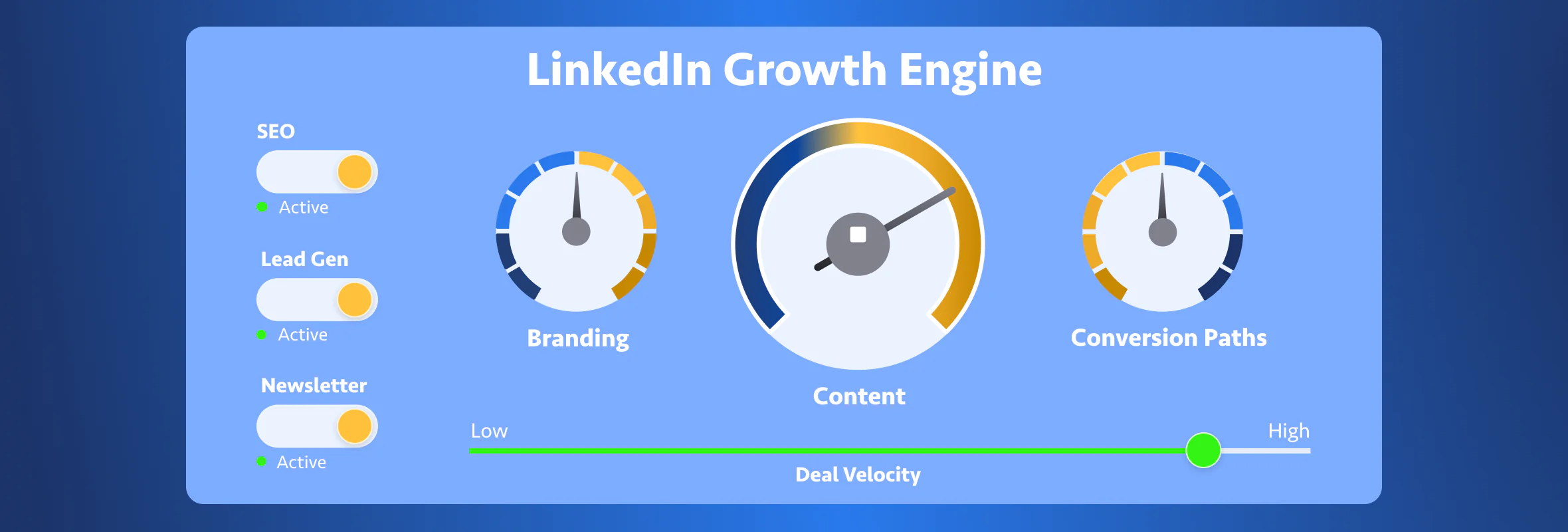
Systematically optimizing every structural element within your profile architecture transforms a stagnant social media page into a high-impact pipeline engine that drives inbound traffic, nurtures early-stage demand, and accelerates deal velocity. Here’s how to build it, step by step.

B2B Marketing Strategy Framework

B2B Marketing Strategy Framework: The Ultimate Guide to Business Branding

Get a more detailed view of the complete buyer’s journey with our downloadable guide.

Step 1: Establish Your Visual Identity with Clear Branding Elements

First impressions dictate credibility, and your visual branding communicates authority before a prospect reads a single word. The quality of your graphic elements subtly signals whether you’re a serious industry player or an organization that hasn’t invested in its digital presence.

Profile Logo (300 x 300 pixels)

Your logo should be high-resolution, perfectly centered, and cleanly framed. A pixelated or off-center logo is an immediate red flag for any discerning buyer. This image also appears across LinkedIn when your employees tag your page, so consistency matters at every scale.

Cover Banner (1128 x 191 pixels)

This is some of the most valuable real estate on your entire page, and most companies either waste it with a generic gradient or leave it blank entirely. Use this space strategically to display:

  • A concise tagline that captures your value proposition
  • A visual snapshot of your core solution offerings
  • A brand-aligned message targeted at your ideal customer profile

Consistent Aesthetics Across Every Touchpoint

Your LinkedIn page should look like a natural extension of your website and other brand materials. Applying your brand identity guidelines consistently, from fonts and hex color contrast to photography style and iconography, contributes to a cohesive visual story. If your page feels disconnected from your homepage, it creates subtle friction in the buyer’s evaluation process.

If your visual brand needs a refresh before you optimize your page, working with a graphic design and branding partner can help you establish a consistent visual system that scales across every digital touchpoint.

Subscribe to EBQ's Bimonthly Newsletter

Step 2: Write a Data-Driven Tagline and About Section

Strong B2B messaging doesn’t happen by accident. Every line of copy on your LinkedIn company page should reflect a deep understanding of your target buyer personas, their industry pain points, the language they use to describe their challenges, and the outcomes they’re actually trying to drive.

The 120-Character Tagline

This brief sentence appears directly below your company name and is often the first copy a visitor reads. It should explicitly answer two questions:

  • Who do you help?
  • What specific problem do you solve for them?

Vague taglines like “Innovative solutions for modern businesses” tell your visitor nothing. A phrase like “Outsourced sales and marketing teams for B2B technology companies” immediately signals relevance.

The “About” Section (2,000 Characters Max)

Your “About” section is one of the most SEO-impactful areas of your entire page. LinkedIn recommends leading with long-tail keywords that your buyers are actively searching. Incorporate these naturally into prose rather than forcing them in.

What to cover in your “About” section:

  • Your organization’s mission and core values
  • Firmographic parameters: company size, location, and industries served
  • A clear overview of your solution offerings and use cases
  • The specific outcomes and ROI your clients experience

Avoid aggressive sales language. Leading with value and education, rather than a hard sell, builds the trust that moves buyers through complex purchasing decisions. That philosophy is central to how content marketing works in B2B, and it applies just as much on LinkedIn as it does on your blog.

Step 3: Leverage Native LinkedIn Profile Tools

A mature LinkedIn company page goes beyond static content. LinkedIn has built a suite of native tools specifically designed to help B2B brands generate leads, build recurring audiences, and drive meaningful engagement, most of which go dramatically underused.

Products icon

Products Tab

LinkedIn's “Products” tab lets you feature up to 35 distinct solution offerings, each with its own description and customer testimonials. Keep in mind that only the 10 most recent product pages will actually display on your profile, so prioritize your highest-impact offerings. This tab functions as a lightweight product catalog embedded directly in your page, a powerful way to showcase your breadth to early-stage researchers.

Native Lead Gen Forms icon

Native Lead Gen Forms

Remove friction from your top-of-funnel conversion process. Native lead gen forms pre-populate with a visitor's profile data and allow you to exchange high-value content, checklists, ebooks, and assessment frameworks for critical prospect contact information without ever sending them off-platform.

LinkedIn Marketing Solutions has also published practical guidance on getting more from lead gen forms, including how to optimize form copy for conversion. Pairing these forms with a solid demand-generation strategy ensures that the leads you capture actually enter a defined nurture sequence rather than sit untouched in a spreadsheet.
Newsletter Icon

LinkedIn Newsletters

This is one of LinkedIn's most underutilized features. A company newsletter automatically triggers push notifications and email alerts to every subscriber each time you publish, effectively bypassing the algorithm's organic reach limitations. Brands that establish a weekly or bi-weekly newsletter build a recurring, opted-in audience that competitors can't easily replicate.

Life icon

The “Life” Tab

Authenticity builds trust in B2B purchasing environments just as much as credentials do. The “Life” tab gives you dedicated space to showcase company culture, employee development initiatives, and executive thought leadership, all of which reinforce the organizational legitimacy that complex buying committees need to see before committing to a vendor relationship.

Step 4: Formulate a Multi-Channel Content Strategy and Posting Cadence

Even a perfectly optimized page will fall flat without a reliable, recurring distribution strategy behind it. A regular content publishing cadence is how your page stays alive. It feeds the algorithm, builds compounding impressions with your target audience, and positions your firm as a primary market resource over time.

We recommend building your content rollout around what we call the 4 C’s Framework:

Clarity

Every piece of content should deliver one clear, actionable message tied to a specific buyer pain point.

Content

Lead with value-first assets, educational insights, industry benchmarks, tactical how-tos, before promotional messaging.

Community

Proactively engage with comments, tag relevant stakeholders, and amplify employee posts to signal active brand participation.

Cadence

Publish on a predictable schedule. Consistency compounds over time; sporadic posting forfeits algorithmic momentum.

Determining Your Content Mix

A well-balanced content calendar doesn’t run on promotional updates alone. Mapping your content to each stage of the B2B buyer’s journey is the difference between a page that bolsters a pipeline and one that just fills a feed. For LinkedIn specifically, we recommend balancing:

  • Top-of-funnel educational content (industry insights, original data, expert commentary)
  • Company news and solution updates (product announcements, case study highlights, award recognition)
  • Third-party curated content (relevant industry articles with your original point of view added)
  • Rich media assets (infographics, short-form video, slide carousels, and event recordings)

Establishing the Cadence

Set a mandatory minimum posting frequency, at least once per week, and treat it like a non-negotiable operational commitment. LinkedIn’s algorithm rewards consistent activity with compounding organic reach, and the data backs it up. Companies that post weekly see significantly higher follower engagement rates than those that post sporadically.

Step 5: Maximize Strategic Alignment via CTAs and Pinned Posts

Traffic and impressions are vanity metrics unless they’re connected to a clear conversion mechanism. The final layer of a fully optimized LinkedIn company page is ensuring that every element, from your header CTA to your pinned post, is explicitly designed to move the right visitors toward a defined next step.

The Primary CTA Button

Treat your CTA button as a live campaign asset — not a set-it-and-forget-it configuration.

LinkedIn allows you to configure a primary call-to-action button directly beneath your header image. Options include Contact us, Visit website, Learn more, Register, and Sign up. Choose the CTA that aligns with your current campaign objective and links to a dedicated landing page, not your generic homepage. CTA architecture and funnel-aligned page hierarchy are among the most critical drivers of conversion rate performance, so treat this button as a live campaign asset rather than a set-it-and-forget-it configuration.

Featured and Pinned Posts

Keep your highest-performing conversion asset, whether that’s a gated benchmark report, a case study, or a free assessment offer, pinned at the top of your company feed. This ensures that every new visitor encounters your best piece of content immediately, regardless of when they land on your page.

Employee Advocacy

Your employees’ combined networks almost always vastly outnumber your company’s direct follower count. Empowering your team to link back to the company page and share organic content amplifies your brand’s reach far beyond what paid impressions alone can deliver. Tracking performance over time against current digital marketing benchmarks will help you understand what realistic growth looks like as your advocacy program scales.

For practical tips on getting more from your page structure, LinkedIn outlines 13 ways to boost company page performance, including completing your profile for 30% more weekly views and how consistent posting doubles engagement.

Don't Let Leads Go Cold — Have a BDR Ready

Here’s the step most companies skip entirely. All of the lead capture mechanics above, forms, newsletter subscriptions, and CTA clicks, only produce opportunities if someone follows up. Designating a business development representative (BDR) to call on LinkedIn-sourced leads within 24 to 48 hours dramatically increases conversion rates. If your team doesn’t have dedicated capacity for that, a professional appointment-setting team can qualify inbound leads and book meetings on your behalf so nothing falls through the cracks.

B2B Marketing Strategy Framework

B2B Marketing Strategy Framework: The Ultimate Guide to Business Branding

Get a more detailed view of the complete buyer’s journey with our downloadable guide.

Continuously Optimizing Your LinkedIn Platform Strategy

Perfecting the structural anatomy of your LinkedIn company page is an ongoing endeavor, not a one-time setup task. Every element covered in this guide contributes to a compounding foundation: visual branding builds trust, keyword-rich copy captures search visibility, native tools reduce conversion friction, consistent content fuels algorithm momentum, and clear CTAs convert interest into leads.

Compare your platform analytics on a rolling 6-month basis. Track upward trends in follower growth, content engagement rate, CTA click-through, and ultimately pipeline attribution from LinkedIn-sourced leads. These benchmarks tell you what’s working, what needs to be adjusted, and where your next optimization investment should go.

Building and sustaining a multi-pronged LinkedIn content strategy can quickly overwhelm internal marketing resources, especially when you’re managing it alongside the rest of your digital footprint.

That’s where EBQ’s certified marketing specialists come in. From writing compelling content and managing your digital platforms to building the demand generation engine that turns LinkedIn curiosity into a qualified pipeline, all for one flat monthly retainer. Visit our B2B Marketing Agency page to kick-start your growth roadmap.

About the Author:

As VP of Marketing at EBQ, Brent has led over 500 lead generation projects at EBQ, specializing in methodical execution and implementing best practices. With 14+ years of experience, including serving as Chief Revenue Officer, he has refined sales fundamentals and optimized processes for diverse industries, driving success in a dynamic market.

Yes, I want to level up my LinkedIn company page.