


This post was originally published in May 2019 and has been updated for accuracy and comprehensiveness.
In today’s digital world, people turn to search engines to look for answers or information. To best capture these searchers’ attention, copywriters must write SEO-optimized content to get highly ranked on search engines — effectively turning curiosity into conversions.
In this chapter, we’ll go over why keywords are important and how to choose keywords for SEO success.
But first, we need to define what keywords are exactly.

Learn how to build a strong brand experience with our downloadable guide.
In digital marketing, keyword research is the process of identifying which specific keywords your page should rank for to attract your target audience and drive traffic to your site.
Ultimately, keywords give marketers insight as to what their target audience is searching for — providing ideas on how to create effective landing pages that meet their site goals.
Keyword research is important because it gives copywriters a framework on how to write copy that converts. Based on this optimized copy, your organization will create effective landing pages that attract a new audience through the increased search visibility.
All effective landing pages should:
A critical step in this research process is selecting the right keywords to target.
Selecting the right keywords requires a strategic approach that involves research, analysis, and continuous optimization. Below are the key steps to guide you through the process:
Every experienced copywriter knows that a strong keyword is broken down into this formula:

Search intent signifies why a person searched, so understanding search intent is arguably the most important step in any keyword research. This helps high-intent users find relevant resources on your website.
There are four key categories of search queries:
Long-tail keywords are any search phrases that utilize three or more words. Otherwise, it’s called a “broad keyword.”
While broad keywords have higher search volume, you should avoid solely targeting broad keywords in your content. Because broad keywords are so generic, they are highly competitive and do not give you enough of a detailed insight into the search intent.
Let’s say you are looking to market a CRM solution for small businesses.
If you target “CRM” as your top keyword, it will be inefficient as you won’t know why they searched “CRM” in the first place.
For example, a searcher could be looking deeper into
Regardless of your hypothesis, you might not be able to attract the right traffic to your site.
On the other hand, targeting “CRM solutions for small businesses” allows you to attract the right niche to your site right out of the gate.
Every landing page on your site should serve a clear purpose. We recommend website designers to frame these purposes as “ideal next steps” for site users.
For example, some common goals are:
With clearly defined goals, landing pages can be aligned to specific stages of the sales funnel. In digital marketing, terms like “TOF” (Top Of Funnel) or “BOF” (Bottom Of Funnel) content indicate which stage of the buyer’s journey the content is intended to support.
Seed keywords are broad phrases that relate to your brand’s core offering, product, or service. Seed keywords will typically evolve into long-tail keywords through research and refinement that develop into highly relevant content.
Going back to the example of being a CRM solution for small businesses. Here are some seed keyword examples:
We recommend performing competitor research and leveraging industry knowledge to identify seed keywords relevant to your brand.

Your goal for this step is to generate long-tail keywords based on your landing page goals. We find that Google is a great resource for competitor analysis and long-tail keyword ideation.
Start by opening a guest browser window and heading to Google. Because Google tailors results based on cookies and past search history, using a guest browser provides a blank slate that eliminates personalization bias and provides more objective, research-driven results.
Next, enter a seed keyword and start refining your search. Take note of Google’s autocomplete search queries, as they provide an idea of how people typically search for answers. Also, take a look at the “People also ask” section on the search engine results page for more keyword ideas.
Once you have a list of 5-10 long-tail keywords, start roleplaying as your buyer persona. Ask yourself, “Why would a buyer persona input this keyword into a search engine?” If the answer aligns with your landing page’s goals and addresses the user’s needs, then the keyword is a strong candidate for the final content piece.
Going back to the CRM example, here is how our copywriters would ideate a few keywords.
We first look at some autocomplete search query options.

Then, we hypothesize why someone may be searching for the keyword.
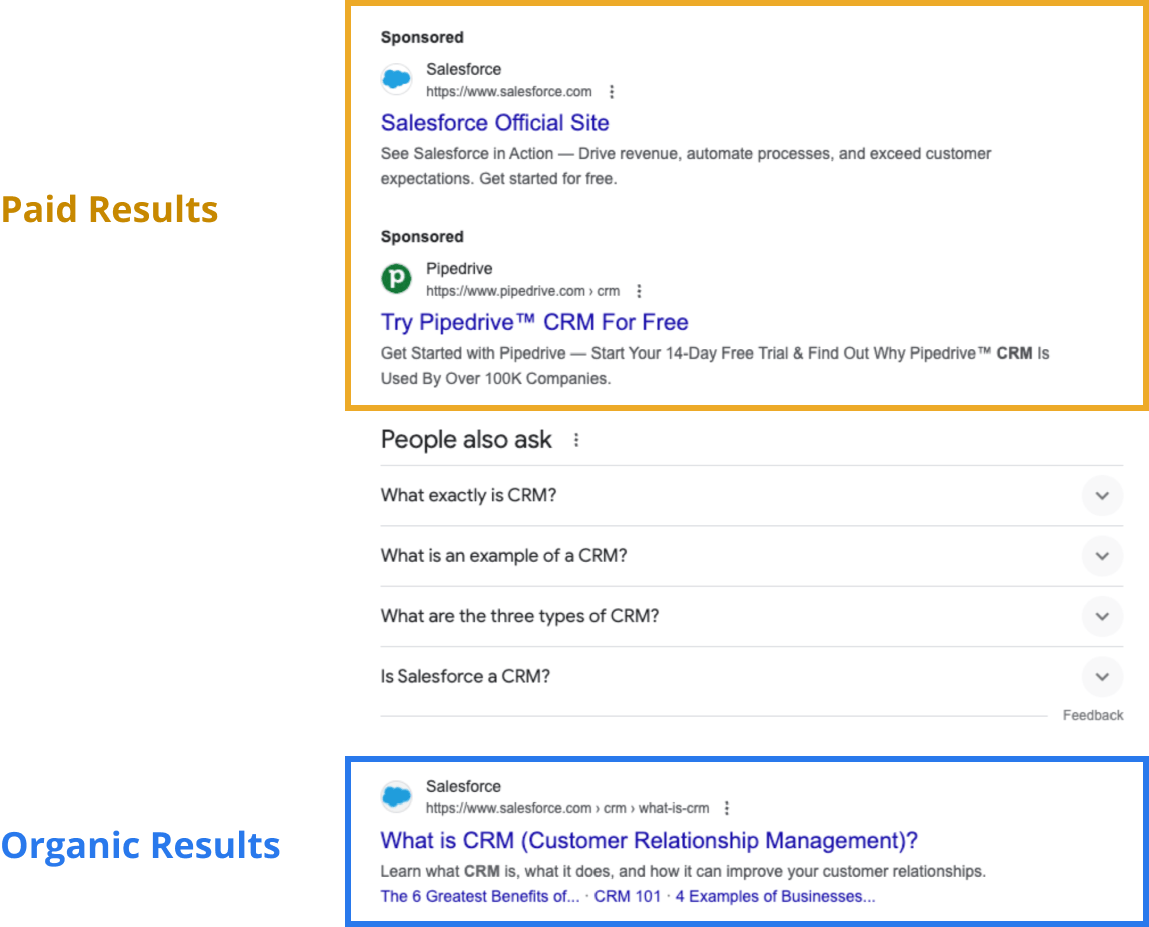
Keep in mind that Google typically displays both paid search ads and organic results. Understanding the differences between the two is essential for accurate competitive and keyword analysis.
We typically do not pay close attention to paid search results when performing keyword research. Generally, high-ranking search ads reflect ad spend, not SEO strength, and can be misleading.
Now that you have a working list of relevant long-tail keywords, it is time to utilize SEO keyword tools to analyze keyword quality. At EBQ, we use Moz because it tends to give straightforward, relevant, and actionable metrics that outperform other tools on the market.
Our copywriters also utilize Moz’s “Keyword Suggestions,” which also helps uncover more keyword opportunities. Use keyword filters to quickly identify high-potential keyword opportunities based on your target audience, search volume, competition level, or relevance to your content goals.
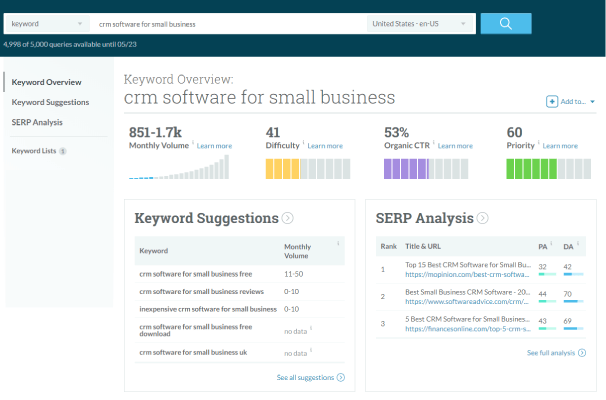
Moz reports on the following metrics:
Out of the four metrics, we often prioritize search volume. After all, a keyword is only valuable if people are actively searching for it. However, an effective keyword strategy considers all metrics for a well-rounded view of a keyword’s true strategic value.
To put it into perspective, a keyword might have a high search volume but is nearly impossible to rank for and/or doesn’t provide enough opportunity for actual clicks. On the flip side, you might easily rank for a keyword, but there just isn’t enough search volume to make any impact.
As you continue to build out your potential keyword lists, we recommend utilizing a sheet to record these keyword metrics. That way, you can distinguish keywords that strike the right balance between high search volume, high CTR, and low difficulty.
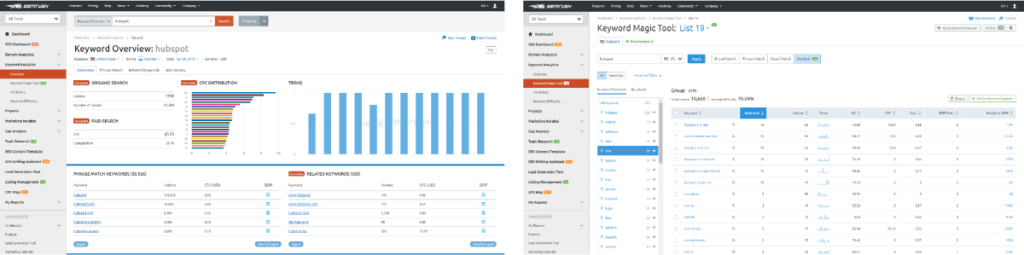
When it comes to market research, it is important to keep tabs on how your competitors are performing. SEO tools, such as Semrush, provide a glimpse into their SEO strategy and performance.
Semrush gives you great insight, such as:
For more information about how to stay search-competitive, check out “SEO Basics Checklist for Blog Posts: How to Improve Your Ranking and Surpass Your Competitors [+ PDF]”. We go over tips on how to strengthen your on-page SEO.
Topic clusters structure your content around one main pillar page, supported by related articles that target multiple relevant search queries. This structure not only enhances user experience but also strengthens your site’s domain authority.
Before drafting any content, review your keyword list and strategically organize keywords into potential topic clusters to ensure comprehensive coverage and improved SEO performance.

Instead of creating one-off landing pages around isolated keywords, topic clusters enable you to build a comprehensive hub of information — which better positions you as an industry thought leader.
Examining our CRM example one last time, let’s say you decided to create a topic cluster on “CRM Implementation Best Practices.”
A few supporting keywords that can be spun out into their own article are:
From a technical standpoint, creating topic clusters helps search engines understand how your content is related, setting you up for better search performance down the line.
Because SEO is a long-term strategy, we recommend checking in on a post’s ranking performance and making adjustments after at least six months of the initial release date.
Google generally prefers recently published content over content that is years old. This means that it is natural for your landing page to lose its competitiveness over time. When that happens, we recommend optimizing your content to maintain its relevance and keep it ranking over time.
Learn how to build a strong brand experience with our downloadable guide.
To outrank competitors, attract highly targeted traffic, and drive stronger conversion rates through data-informed content, follow these keyword research steps:
The right keywords are crucial to attracting the right audience. But finding relevant, long-tail keywords with the right search intent to capture your prospects’ attention is a time-consuming task. Not every organization has the resources to dedicate to their search engine marketing strategy.
That’s why many choose to outsource their content marketing team. Our writers and SEO professionals can help identify high-converting keywords and write content that outranks your competitors. Visit our SEO Copywriting service page to learn more.