


With hundreds or even thousands of prospects in your database, how do your sales reps know which leads to prioritize? A standardized lead rating system allows your sales reps to grade leads based on their likelihood to convert — which can inform your other sales strategies, such as your sales cadence and messaging.
In this post, we dive into what a lead rating is, our EBQ Rating system, and how to integrate it into your sales process.
Lead Rating 101
What is a lead rating?
A lead rating is a qualitative system that measures a prospect’s likelihood of converting.
What is lead rating vs lead scoring?
Lead ratings are typically more qualitative and people-driven. Sales reps typically are responsible for rating each lead to determine their follow-up strategy.
On the other hand, lead scoring is an automated model that assigns numerical points based on the prospect’s actions — such as downloading a guide or clicking an email link. Based on these lead scores, a marketer can determine how to nurture these prospects best.
What is the EBQ Rating?
The EBQ Rating determines the likelihood that a prospect will agree to a sales meeting. If a prospect is disqualified, the EBQ Rating also gives corresponding scores to inform future lead generation strategies.
How do you implement a lead rating system?
Make sure your sales and marketing teams are trained on using the lead rating system. To make it easy for your teams to access the EBQ Rating, record it in your lead generation documentation.

Download the Ultimate B2B Appointment Setting Guide
Download the B2B Appointment Setting Guide to learn how to properly prospect and cold-call best practices.
What is a lead rating?
A lead rating is a qualitative system that measures a prospect’s likelihood of converting. Instead of reading through pages of customer notes to determine how close a lead is to agreeing to a sales meeting, your reps can now use a single score to quickly ideate their next steps.
Lead Rating vs Lead Scoring
Although both terms are often used interchangeably, lead rating and lead scoring serve different purposes in the lead generation process.
Lead rating is often manually calculated by a sales development team based on their interactions with individual prospects. Some of these interactions include:
- The prospect’s level of hesitance when responding to cold outreach
- The prospect’s ability to influence purchasing decisions within the organization
- The prospect’s objections during cold calls
Lead scoring, on the other hand, is often calculated using marketing automation platforms. While lead rating focuses on interactions between prospects and a business development representative (BDR), lead scoring focuses on the prospect’s actions and level of engagement with marketing materials.
A few examples of such actions include:
- Downloading a guide
- Clicking a link within an email
- Filling out a contact form
- Responding to a newsletter
- Unsubscribing from your emails
As a best practice, your lead rating and lead scoring system need to be integrated to maximize conversions through a sales cadence, which determines how often and when you follow up with a prospect to ensure maximized follow-ups with minimal friction.

Subscribe to EBQ's Bimonthly Newsletter
Subscribe to EBQ's Bimonthly Newsletter
The Only Lead Rating System You Need: The EBQ Rating
Created by EBQ’s cofounder and CEO, Tim Edwards, the EBQ Rating is a lead rating system that measures how close a prospect is to agreeing to a sales meeting. You might notice that the rating even includes marketing leads to ensure our BDRs also follow up on high-intent marketing leads.
Let’s break down each score with an example:
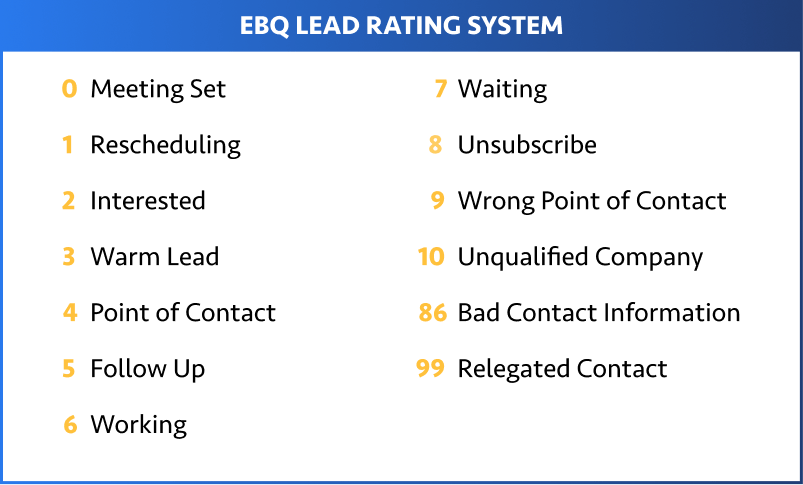
| EBQ Rating | Explanation | Example |
|---|---|---|
| 0 – Meeting Set | The prospect has agreed to a sales meeting/product demo. | A prospect confirms that they plan to attend a sales meeting. |
| 1 – Rescheduling | The prospect had initially agreed to a sales meeting, but they decided to postpone. | A prospect emails a business development rep to reschedule their sales meeting. |
| 2 – Interested | The prospect is about to commit to a meeting date. | A prospect is getting their coworker’s schedules to determine when’s the best time to meet with your sales rep. |
| 3 – Warm Lead From Marketing, Not Yet Spoken To | The prospect has engaged with marketing materials that suggest a high interest in your products. | A prospect fills out a “Contact Us” form to learn more about your solution. |
| 4 – Point of Contact, Not Yet Spoken To | A past or current customer referred your solution to the prospect. | A prospect indicates that they are referred to by a point of contact, but your reps have not engaged with them yet. |
| 5 – Follow Up | The prospect indicates that they might consider investing in your solution in the future. | The prospect is waiting for their next quarter’s funding, so they would like to postpone all sales conversations until they get a clearer picture of their budget. |
| 6 – Working | Your BDR is actively contacting the prospect — pushing them further down your sales funnel. | Your BDR has done their initial research and is cold calling your prospect. |
| 7 – Waiting | The prospect has been identified as a viable lead from a data team, but your BDR has yet to connect with them. | Your data broker has determined that the prospect matches your ideal customer profile and has listed your prospect’s contact information for you to contact. |
| 8 – Unsubscribe | The prospect has unsubscribed from your mass marketing messages. | The prospect responded to a newsletter and requested to be taken off your email list. |
| 9 – Wrong Point of Contact | The prospect is not the right person to contact. | The prospect is a gatekeeper and not a decision-maker, so your BDR should focus on nurturing someone else within the organization. |
| 10 – Unqualified Company | The prospect’s company falls outside of your ICP, thus making them an unviable prospect. | The prospect’s organization location falls outside your service area. |
| 86 – Bad Contact Information | The prospect’s contact information is incorrect, whether due to an invalid entry or an outdated source. | Once your marketing materials were delivered, the prospect’s email address returned a hard bounce. |
| 99 – Relegated Contact | The prospect has not been engaging with your outreach attempts. | The prospect has not engaged with any of your email marketing materials and has exited the journey. |
We have found that the EBQ Rating creates a more unified pipeline, as it integrates warm marketing leads into our sales processes. As a result, it becomes more important than ever for sales and marketing teams to stay aligned — sharing insights, coordinating outreach, and maintaining a consistent experience for every prospect.
Download the Ultimate B2B Appointment Setting Guide
Download the B2B Appointment Setting Guide to learn how to properly prospect and cold-call best practices.
Turn leads into opportunities with EBQ
You always want to strike while the iron is hot, so a lead rating system gives your sales reps a framework to understand which leads to prioritize. Leveraging the EBQ Rating grants you more control over who to prioritize and understand why a prospect was disqualified.
Of course, a lead rating system only plays a role in the lead generation process. If you’re struggling to optimize your revenue operations cycle, consider partnering with EBQ. We have sales experts, marketing specialists, and CRM administrators who work together to provide a unified view of your entire sales process — ensuring every stage is aligned, measurable, and optimized for growth.
About the Author:
Dalia is EBQ’s VP of Customer Experience with over 10 years of experience in customer service. After forming the Customer Experience division, she achieved over $1.2M in revenue within the first six months under her leadership.