
Inbound vs ABM: Why You Need to Start Leveraging Account-Based Marketing


Donte Hamilton
Every marketing team faces the same baseline challenge: how do you maximize qualified lead generation with a fixed budget and bandwidth? The answer: make sure your marketing strategy is optimized to attract high-quality leads that convert into paying customers.
Two of the most popular marketing approaches include inbound marketing and account-based marketing (ABM) tactics. While most business leaders see them as competing methodologies, you can (and should) leverage both to maximize lead conversion.
In this post, we’ll go over:

B2B Marketing Strategy Framework: The Ultimate Guide to Business Branding
Looking to create a strong B2B marketing strategy? This guide walks you through planning a data-driven marketing campaign.
What does ABM stand for in marketing?
ABM stands for “account-based marketing.” Coined in the early 2000s, this approach was designed to align sales and marketing and focus on high-value accounts within a target market by delivering highly personalized customer experiences.
62% of consumers agree that personalized recommendations are better than general ones, with business leaders finding that the process delivers on both lower customer acquisition costs and better customer retention. Consumers feel the difference. And when personalization is done right, the business feels it too. Popular personalization techniques include tailoring messaging to specific pain points, aligning sales and marketing touchpoints, and using CRM data to deliver timely, relevant outreach.

Subscribe to EBQ's Bimonthly Newsletter
Subscribe to EBQ's Bimonthly Newsletter
Traditional Inbound vs Account-Based Marketing
Unlike ABM, traditional inbound marketing focuses on attracting as many prospects as possible by creating captivating content. By creating lead magnets and nurturing colder leads now, you can convert them into qualified leads over time.
| Factor | Traditional Inbound | ABM |
|---|---|---|
| Goal | Attracting as many prospects as possible through content creation and omnichannel marketing activities | Building relationships by treating each account as its own “market” |
| Strategy | Creating content that covers the entire sales funnel | Targeted outbound outreach, such as leveraging paid ads, cold calls, and marketing emails |
| Level of Personalization | Typically, a persona-based level of personalization (i.e., you’re marketing to a single person) | Account-based level of personalization (i.e., drilling down on your ICP to inform marketing activities) |
| Key Metrics | MQLs, organic traffic, and content engagement | Win rate, pipeline velocity, and average deal size |
| Ideal for | Organizations targeting smaller decision-making groups | Organizations with a complex buying process |
As with so many things, success lies in the balancing of elements of traditional inbound marketing and ABM to sustain a healthy pipeline. By leveraging both inbound and outbound activities, you can attract prospects who are actively looking for your solutions while simultaneously building strategic relationships with target accounts.
Given that over 70% of businesses already leverage inbound marketing, gaining organizational support for developing further inbound initiatives is typically less challenging than designing and operationalizing an ABM strategy from scratch.
5 Key Benefits of Account-Based Marketing
If leadership alignment is the goal, here are five reasons ABM is worth prioritizing:

1. Keeps marketing and sales aligned
Did you know that businesses with highly aligned sales and marketing departments typically achieve 30% higher sales win rates? ABM was designed to strengthen the cross-departmental relationship, encouraging both teams to collaborate and ensure that every effort is coordinated and focused on the accounts most likely to convert.
By leveraging ABM, your two departments now:
- Focus on the same accounts and goals
- Stick to the mutually agreed-upon budget
- Define specific roles of each internal stakeholder
- Create a seamless buyer’s journey for higher win rates
In the end, businesses with highly aligned sales and marketing departments become 67% more effective in closing deals and save 30% on customer acquisition costs alone.
2. Higher close rates
According to recent studies, over 80% of marketers attribute higher win rates to ABM. That’s because ABM requires both sales leaders and marketers to create tailored content that really resonates with your target audience.
To clarify, you’re not just updating a call-to-action here or there. You are personalizing every detail of your marketing campaigns, such as:
- Product information
- Objections and responses
- Email campaigns
- Paid social media ads
As a result of adopting ABM, 70% of companies report improved account engagement — resulting in higher customer acquisition and retention.
3. Better ROI reporting
One of the biggest headaches any business leader faces is figuring out how to show their impact using hard metrics. For example, many marketers are often frustrated because they have no visibility into how their marketing efforts convert into sales opportunities.
Since ABM requires both sales and marketing to be transparent with one another, this leads to a natural increase in visibility. Both departments need to regularly meet to make sure their target accounts are moving down the sales funnel and make adjustments accordingly.
Today, almost 90% of marketers say that ABM is delivering a higher return on investment than other marketing strategies thanks to better reporting and data-driven decisions.
Subscribe to EBQ's Bimonthly Newsletter
Subscribe to EBQ's Bimonthly Newsletter
4. Shortened sales cycles
64% of surveyed companies report that their sales cycle has decreased just from leveraging account-based marketing. In other words, buyers are taking less time committing to a solution because ABM delivered highly personalized messaging that built trust faster.
Let’s examine the typical ABM process:
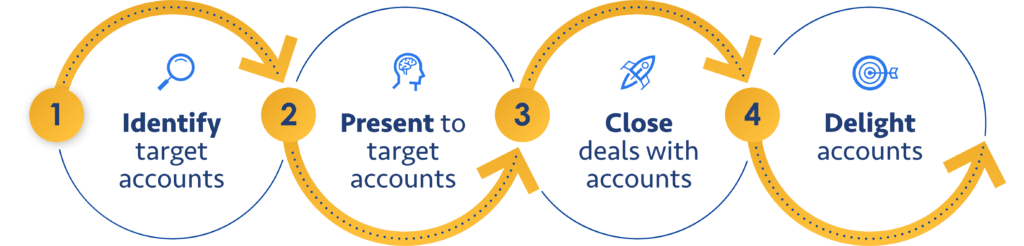
Throughout the steps, you’ll notice the word “account.” As opposed to the traditional marketing funnel that focuses on attracting and nurturing leads in bulk, you’re now focusing on the individual accounts and leveraging a sales cadence based on their specific needs.
From our experience, prospects ultimately trust those who take the time to really listen to each individual’s concerns with a drive to truly understand their decision drivers.
5. More wins down the line
Over 70% of companies say that leveraging ABM has helped them create stronger customer relationships. And stronger customer relationships ultimately mean higher customer satisfaction.
Research shows that happy customers make the best brand advocates. Think about it: when researching a restaurant, which carries more weight — glowing reviews on Yelp, or the chef personally insisting the restaurant is exceptional?
We’ve seen that happy customers often lead to higher word-of-mouth referrals and even testimonials that attract new customers. Therefore, satisfying customers should start at the beginning of the sales funnel.
B2B Marketing Strategy Framework: The Ultimate Guide to Business Branding
Looking to create a strong B2B marketing strategy? This guide walks you through planning a data-driven marketing campaign.
Sharpen your marketing with ABM.
When leveraged with inbound marketing, you can both attract and retain high-value accounts using account-based marketing — all while improving your cross-departmental alignment. However, that takes a level of tact and preparation for you to really enjoy the fruits of your labor.
EBQ’s marketers understand how to zero in on your target accounts and create an omnichannel strategy to better target and convert leads into paying customers. By combining data-driven insights with tailored messaging, they ensure each interaction moves accounts closer to purchase.
About the Author:
Donte is a seasoned sales development expert with 20+ years of experience and has built and trained teams for startups and mid-sized businesses. Joining EBQ in 2015, he advanced from Operations to Revenue Cycle Consultant, leveraging his expertise to help businesses scale revenue. Known for positioning offerings to captivate Ideal Customer Profiles, Donte’s ability to address pain points and decision drivers during sales discussions cements his reputation as an industry leader.